
 Contact Us

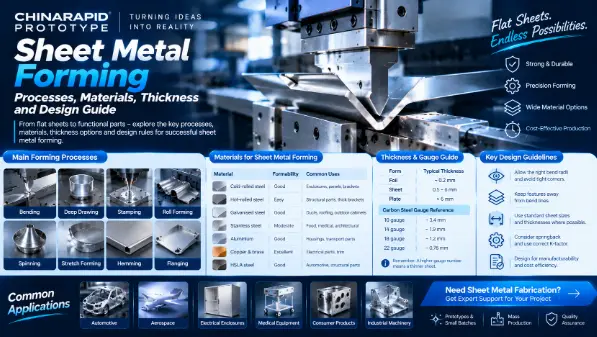
Sheet Metal Forming - Processes, Materials, Thickness and Design Guide


Table of Contents

Sheet metal forming turns flat sheet into three-dimensional parts by applying force until the metal deforms permanently, with no material removed. It produces the bends, curves, cups and ribs found in enclosures, brackets, panels, housings and vehicle structures. Choosing the right forming method, material and thickness early decides whether a part is cheap and repeatable or expensive and troubled by cracking and distortion.
This guide covers what counts as sheet metal, how thickness and gauge work, which materials form best, the main forming processes, the parameters that control accuracy, and how to choose between methods. For the full workflow from cutting to finishing, see our sheet metal fabrication service page.
What Counts as Sheet Metal?
Sheet metal is flat metal stock that is thin relative to its length and width. The usual thickness boundaries are:
| Form | Typical thickness |
| Foil | below about 0.2 mm |
| Sheet | about 0.5 mm to 6 mm |
| Plate | above 6 mm |
Thinner sheet forms easily and keeps good strength at low cost, which is why it appears in so many products. Plate usually needs heavier equipment and is more often hot formed or cut and welded.
Thickness, Millimetres and Gauge
Thickness is quoted in three ways: millimetres, mils (one thousandth of an inch) and gauge. Gauge is where mistakes happen:
- A higher gauge number means a thinner sheet.
- Gauge is tied to weight per unit area, so the same gauge gives different thicknesses for different metals. For example, 16-gauge carbon steel is about 1.5 mm, while 16-gauge aluminium is about 1.3 mm, and galvanised steel is slightly different again because of its zinc layer.
- Many standards discourage gauge, so always state thickness in millimetres on drawings.
A few reference points for carbon steel: 10 gauge is about 3.4 mm, 14 gauge about 1.9 mm, 18 gauge about 1.2 mm and 22 gauge about 0.76 mm.
Practical tips
- Pick a standard thickness that is readily stocked. Non-standard thicknesses can cost more and take longer to source.
- Check standard sheet sizes before finalising part dimensions. A part just larger than a standard sheet wastes material and raises cost.
- Oversized sheets are not always in stock, and not every shop can cut or form them, so confirm capability before you commit to large parts.
Hot-Rolled vs Cold-Rolled Sheet
Steel sheet is made by hot rolling or cold rolling, and the difference affects forming:
- Hot-rolled sheet is rolled at high temperature. It is cheaper and easier to form, and thicker plate is almost always made this way. The metal shrinks as it cools, so dimensions and flatness are less accurate and the surface is rougher.
- Cold-rolled sheet is rolled at room temperature after hot rolling. It has a smoother surface and tighter dimensional control, which suits precision parts, visible surfaces and anything to be painted. For carbon steel it is typically limited to about 3 mm.
For stainless steel, cold rolling covers the full sheet range up to about 6 mm.
Materials for Sheet Metal Forming
Formability depends on ductility, strength, thickness, grain direction and temper, not on the metal family alone. The common choices are:
| Material | Forming behaviour | Typical uses |
| Cold-rolled steel | Good formability, smooth finish, needs coating against rust | Enclosures, appliance panels, brackets |
| Hot-rolled steel | Easy to form, rougher surface, looser tolerances | Structural parts, thick brackets |
| Galvanised steel | Forms well, zinc layer protects against corrosion | HVAC ducts, roofing, outdoor cabinets, electrical boxes |
| Stainless steel (304, 316) | Strong, work-hardens, higher forming force and more springback | Food, medical and architectural parts |
| Aluminium (5052, 6061) | Light, corrosion resistant. 5052 bends better than 6061 | Housings, panels, transport parts |
| Copper and brass | Very formable, conductive, decorative | Electrical parts, trim |
| HSLA steel | Higher strength allows thinner sections | Automotive and structural parts |
Galvanised Steel in Detail
Galvanised sheet is carbon steel coated with zinc. The zinc acts as a barrier and as a sacrificial layer: if the surface is scratched, the zinc corrodes first and slows rust on the steel underneath. That makes it a strong choice for outdoor, humid and coastal service and for parts that will be stored or shipped before use.
- Coating weight is given in g/m², commonly from Z30 up to Z600. Heavier coatings protect longer but are harder on tooling and bends.
- Surface options include regular, minimised or zero spangle. Zero spangle gives a cleaner look for painted parts.
- Treatments such as passivation, oiling or anti-fingerprint layers help against white rust and handling marks.
- Common standards are ASTM A653, EN 10346, JIS G3302 and GB/T 2518.
- Typical matches: roofing and cladding use heavier zinc (about Z120–Z275), ducting and appliance housings use lighter zinc (about Z60–Z180), and automotive inner panels use thinner coatings with good weldability and paint adhesion.
Forming allows for the coating: use adequate bend radii, avoid sharp bends and check that coating adhesion is strong enough to resist flaking. Welding galvanised steel needs ventilation and attention to the zinc fume.
For grades and stock we can supply, see our materials page.
Sheet Metal Forming Processes
Bending
A press brake folds the sheet along a straight line between a punch and a die. It is the most common forming step and underlies brackets, channels, boxes and covers.
- V-bending uses a V-shaped die. It includes air bending, bottoming and coining.
- Air bending lets the punch depth set the angle, so one tool makes many angles, with more springback.
- Bottoming presses the sheet into the die for more consistent angles.
- Coining uses very high force to set the bend and nearly remove springback.
- Wipe (edge) bending forms flanges along an edge.
- Roll bending curves the sheet into cylinders, cones and large radii.
Roll Forming
A strip passes through successive roller stations, each bending the material a little more until the full profile is formed. It suits long parts with a constant cross-section, such as roof panels, rails, channels and shelving, and runs at high volume. Punching, notching and cutting to length can be done in-line.
Deep Drawing
A punch pushes a blank into a die cavity while a blank holder controls material flow, making cups, cans, sinks and housings. It is called deep drawing when the depth exceeds the diameter. Several draw stages may be needed, and ductile metals such as aluminium, brass, copper and mild steel work best. Cost is driven by tooling, so it suits higher volumes.
Stamping
A press and a dedicated die shape the sheet in one stroke or in a progressive series of stations. Operations include blanking, punching, bending, embossing, flanging and coining. Stamping delivers high repeatability and low per-part cost at volume, with high tooling investment. See our precision metal stamping mold projects for examples.
Stretch Forming
The sheet is gripped at its edges, pulled into tension and wrapped over a form block. It makes large, smooth, shallow-curved parts such as aircraft skins and body panels, with little springback and a good surface.
Hydroforming
Fluid pressure replaces one half of the tooling, pressing the sheet onto a single die. It handles complex curves with fewer tools and less surface marking, and it suits smaller batches, though equipment is specialised and cycles are slower.
Metal Spinning
A disc spins on a lathe while a roller presses it over a mandrel, making round, conical and domed parts. Conventional spinning keeps thickness roughly constant, while shear spinning deliberately thins the wall.
Curling, Hemming and Ironing
- Curling rolls an edge into a hollow ring to stiffen it and remove sharp edges.
- Hemming folds an edge back on itself to hide burrs and add strength.
- Ironing thins the walls of a drawn part for uniform thickness, as in beverage cans.
Incremental Forming, Wheeling and Expanding
- Incremental forming shapes sheet with a small round-tipped tool following a CNC path. It needs no dedicated die, so it suits one-offs and prototypes.
- Wheeling stretches sheet between wheels to make compound curves by hand. It is skilled, slow and used for low-volume custom panels.
- Expanding slits and stretches sheet into a diamond mesh for grating, fencing and filters.
Cutting Steps That Support Forming
Forming rarely stands alone. Blanks are usually cut first by laser, punching or shearing. Laser cutting handles complex outlines and fine detail with fast design changes, and punching suits high-volume holes. Photochemical etching suits very thin, fine-featured parts. See the sheet metal projects page for finished examples.
Key Parameters That Control Forming Accuracy
K-Factor
During bending, the outer surface stretches and the inner surface compresses. Between them is a neutral axis that barely changes length. The K-factor is the distance from the inside surface to that axis divided by sheet thickness:
K = t ÷ T
It usually falls between about 0.3 and 0.5 and depends on material, thickness, bend radius and bending method. Use values validated by test bends or the fabricator’s bend tables rather than a generic default.
Bend Radius
The inside bend radius should suit the material, thickness, temper, grain direction and tooling. A radius that is too tight causes cracking, and a good starting rule is an inside radius at least equal to the thickness. Using radii that match existing tooling reduces setup and cost.
Bend Allowance and Bend Deduction
These calculate the flat pattern length:
- Bend allowance: BA = θ × (R + K × T), where θ is the bend angle in radians, R is the inside radius and T is thickness.
- Bend deduction: BD = 2 × (R + T) × tan(θ ÷ 2) − BA
Springback
After the load is released, the metal partly recovers elastically, so the bend angle opens slightly. Higher strength and larger radii increase springback. Stainless steel and high-strength steels show more of it. Compensate by overbending, adjusting tooling, or coining, and confirm with test bends.
Die Clearance
The gap between punch and die affects cut quality, burrs, force and tool life in punching, and material flow and wall thickness in drawing. Use values specific to the operation, material and thickness.
Grain Direction
Rolling gives sheet a grain. Bending across the grain is safer, while bending along it raises the risk of cracks, especially with tight radii or harder tempers.
Common Forming Defects and How to Prevent Them
| Defect | Cause | Prevention |
| Cracking or tearing | Radius too tight, brittle temper, bend along grain | Increase radius, change grain orientation, use softer temper |
| Wrinkling | Too little blank-holder force, thin sheet | Adjust blank holder, add draw beads, change blank shape |
| Springback | High strength, large radius | Overbend, coin, or use test bends |
| Thinning and necking | Excess stretching | Redesign depth or add stages |
| Burrs | Worn tools, wrong clearance | Maintain tooling, correct clearance, deburr |
| Orange peel | Coarse-grained material | Choose fine-grain stock |
| Oil canning | Residual stress in thin flat panels | Add stiffening beads and ribs |
| Galling | Friction between sheet and die | Lubricate, improve tool surface |
| Warping | Residual stress, uneven heat | Plan forming order, stress relieve |
Design Guidelines for Formed Parts
- Hold wall thickness uniform and use one sheet gauge per part.
- Set inside bend radius at least equal to thickness, and keep it consistent across the part.
- Add bend reliefs at bend ends to prevent tearing. Make the relief at least as wide as the sheet thickness.
- Keep holes away from bends. A common guide is at least 2× thickness from a bend and 1× thickness from an edge, with hole diameter at least equal to thickness.
- Allow minimum flange length of about 2× thickness plus bend radius so the part seats properly in the die.
- Respect grain direction for tight or critical bends.
- Avoid unnecessary forming. Extra bends and cuts add cost without function and can make a part impossible to form.
- Plan the sequence so tooling can reach each bend and later operations do not damage earlier features.
- Specify tolerances sensibly. Sheet metal tolerances are looser than machined parts because bends stretch the material. Call out only critical dimensions.
- Add ribs, beads and gussets to stiffen thin parts rather than increasing thickness.
For process capability and what we can hold, see our tolerance and quality control page.
Choosing the Right Forming Method
| If you need… | Consider |
| Simple brackets, boxes, enclosures at any volume | Press brake bending |
| Long constant profiles in large quantities | Roll forming |
| Deep cups or housings at higher volume | Deep drawing or stamping |
| High-volume repeatable parts with dedicated tooling | Stamping (progressive die) |
| Large smooth curved panels | Stretch forming |
| Complex curves in small batches | Hydroforming or incremental forming |
| Round, conical or domed parts | Metal spinning |
| One-off or prototype shapes without tooling | Press brake, incremental forming or wheeling |
Volume rule of thumb: use flexible methods (press brake, laser cutting, incremental forming) for prototypes and low volume, and move to dedicated tooling (stamping, drawing, roll forming) when quantities justify the tooling cost.
Other processes to compare:
- A thick, solid or highly detailed metal part may suit CNC machining better than forming.
- Complex hollow or organic shapes may suit 3D printing.
- Plastic housings at volume suit injection molding.
- Small plastic batches suit vacuum casting.
Finishing Formed Parts
Forming can leave tool marks and sharp edges, and the surface often needs protection. Common options are deburring, bead blasting, powder coating, painting, plating, anodising for aluminium, and passivation for stainless steel. Finishing can add thickness and change fit, so account for it on mating parts. See surface finishing and CMF surface finishing for what is available.
From Prototype to Production
A typical path starts with a laser-cut and press-brake prototype to validate fit and function, adds welding, hardware and finishing for functional builds, and then moves to tooling when volumes justify it. This keeps early cost low and uses the prototype to confirm bend radii, flat patterns and tolerances before tools are cut. See our prototype design and rapid prototyping pages, and our low volume production service for the next step. For tooling projects, see rapid tooling projects.
Applications by Industry
- Automotive: brackets, reinforcements, underbody parts and panels. See automotive.
- Aerospace: skins and structural parts. See aerospace.
- Consumer electronics: frames and housings. See consumer electronics.
- Home appliances: housings, back panels and casings. See home appliance.
- Medical devices: stainless enclosures and trays. See medical devices.
- Industrial equipment and automation: guards, frames, covers and fixtures. See industrial equipment and automation.
- Robotics: structural parts and brackets. See robotics.
FAQ
What is the difference between sheet metal forming and sheet metal fabrication?
Forming reshapes sheet by plastic deformation. Fabrication is the broader workflow that includes cutting, forming, joining and finishing.
What thickness is sheet metal?
Roughly 0.5 mm to 6 mm. Thinner is foil and thicker is plate.
Does a higher gauge mean thicker metal?
No. A higher gauge number means thinner sheet, and the same gauge differs between metals.
Which metal is easiest to form?
Low-carbon steel, aluminium 5052 and copper are very formable. Stainless steel and high-strength steels need more force and allow for more springback.
How do I reduce springback?
Overbend the part, use bottoming or coining, choose a more ductile temper, and validate with test bends.
Can galvanised steel be formed and welded?
Yes. Allow for the coating in radii and tooling, and use proper ventilation when welding.
Which forming method is cheapest?
For small quantities, press brake bending and laser cutting. For high volumes, stamping and roll forming have the lowest per-part cost despite tooling.
Ready to form a part? Send your drawings and 3D models and our engineers will review them for forming feasibility, tolerances and cost.
- PREV: Null
- NEXT: Null
Talk to the Manufacturer, Not a Middleman
Resources & Insights
-
Blog
Household Appliance Prototyping Services: From Concept to Market-Ready Products
2026-10-26By -
 Blog
Rapid Prototyping 3D Printing- Methods, Materials, Process and How to Choose
2026-10-23By -
 Blog
Sheet Metal Forming - Processes, Materials, Thickness and Design Guide
2026-10-23By -
 Blog
Low Volume Appliance Manufacturing Methods and Processes
2026-10-23By


