
 Contact Us

Sheet Metal Fabrication- Process, Materials and Design Guidelines


Table of Contents

Sheet metal fabrication turns flat metal sheets into functional parts and assemblies through cutting, forming, joining and finishing. You will find its output in car bodies, aircraft skins, electrical enclosures, medical equipment and kitchen appliances. It suits both one-off prototypes and large production runs because it needs little tooling and scales easily.
This guide covers the full workflow: the process, cutting and forming methods, joining, material choice, finishes and the design rules that keep parts cheap and manufacturable. If you are ready to start a project, see our sheet metal fabrication service.
What Is Sheet Metal Fabrication?
Sheet metal fabrication is a group of manufacturing operations that shape flat metal stock, usually from about 0.5 mm up to 6 mm thick for most prototype work, into three-dimensional parts. Nearly every operation falls into one of two groups: material is cut away, or it is formed without being removed. Joining and finishing then complete the part.
Typical outputs include:
- Enclosures and chassis
- Brackets and mounting plates
- Frames, panels and covers
- Vents, trays and housings
Because the same sheet can be cut, bent and welded in many ways, a good fabricator picks the route that balances cost, tolerance and lead time. That choice usually starts at the design stage.
The Sheet Metal Fabrication Process, Step by Step
- Design and CAD modelling. Engineers define geometry, material, thickness, bend radii and tolerances. The flat pattern is exported as a DXF or similar file.
- DFM review. A manufacturability check flags features that are too close to bends, radii that are too tight and tolerances that will inflate cost. See our DFM review approach for how this works in practice.
- Cutting. Laser, plasma, waterjet or mechanical methods produce the flat blank.
- Forming. Press brakes, rollers, stamping dies or spinning tools shape the blank.
- Joining and assembly. Welding, riveting, fastening or bonding combines the pieces.
- Post-processing and finishing. Heat treatment, deburring, coating and plating improve function and appearance.
- Inspection. Dimensional and visual checks confirm the part meets drawing requirements.
Projects rarely follow this order exactly. Powder-coated parts, for example, are often coated before fastener assembly, and some parts are formed before cutting.
Sheet Metal Cutting Methods
Laser Cutting
A focused, CNC-controlled beam melts through the metal. It gives the best mix of speed, precision and edge quality for thin to medium sheet. Kerf is typically 0.1–0.3 mm and tolerances around ±0.1 mm are common. The trade-off is a small heat-affected zone, and efficiency drops as thickness rises.
Plasma Cutting
An electrical arc and ionised gas melt conductive metals. It is much cheaper for thick plate (roughly above 10 mm) but leaves rougher edges, more dross and poorer squareness than a laser.
Waterjet Cutting
A high-pressure water stream, often carrying abrasive, cuts almost any material with no heat-affected zone. It handles very thick stock and heat-sensitive alloys, but it is slower, costs more and has a wider kerf (about 0.5–1 mm).
Shearing, Punching and Blanking
These mechanical methods cut with a punch and die or blades. Shearing is economical for straight cuts. Punching and blanking excel at high volumes of repeated shapes but need dedicated tooling, so they rarely make sense for a few parts.
| Method | Best for | Edge quality | Relative cost | Heat-affected zone |
|---|---|---|---|---|
| Laser | Thin–medium sheet, fine detail | Excellent | Medium–high | Small |
| Plasma | Thick conductive plate | Rough | Low | Yes |
| Waterjet | Thick or heat-sensitive material | Very good | High | None |
| Punching / shearing | High volume, simple shapes | Good (burr on one side) | Low per part at volume | None |
For a deeper comparison, read our guide to laser cutting vs waterjet vs plasma cutting, or order directly through our laser cutting service.
Sheet Metal Forming Methods
Bending. A press brake forces the sheet into a V-shaped die along a straight axis. It is the most common forming step and the hardest to get right, because every bend stretches the metal and the metal springs back slightly afterwards. Fabricators compensate by overbending. Our sheet metal bending page covers capabilities.
Stamping. A press forces the blank into a die to create embossed, flanged or contoured features. Progressive dies combine several operations in one stroke, which makes stamping the right choice at high volume.
Rolling and roll forming. Rollers curve the sheet or form continuous profiles.
Deep drawing. A punch pulls a blank into a die to make cup- or box-shaped hollow parts.
Metal spinning. A rotating disc is pressed over a mandrel to form round, conical or cylindrical shapes.
Hemming and curling. Edges are folded or rolled to remove sharp edges and add stiffness.
Joining and Assembly
| Method | Strength | Reversible | Notes |
|---|---|---|---|
| Welding (MIG/TIG/spot) | Very high | No | Heat can distort thin sheet. TIG gives more control, MIG is faster |
| Brazing / soldering | Moderate | No | Lower temperatures, good for dissimilar metals and leak-tight joints |
| Rivets | Moderate | No | Joins dissimilar materials, needs overlapping joints |
| Threaded fasteners and PEM inserts | Moderate | Yes | Easy to service, low cost |
| Adhesive bonding | Lower | Rarely | Joins metal to plastic or wood, no heat |
Choose the joint by load, serviceability and appearance. Fasteners make sense when a part must be disassembled, and welding is better where rigidity or sealing matters.
Sheet Metal Materials
Material choice affects formability, weight, corrosion resistance, weldability and price. The common options are:
| Material | Strengths | Limitations | Typical uses |
|---|---|---|---|
| Aluminium 5052 | Light, corrosion resistant, bends well | Lower strength | Enclosures, chassis, transport |
| Aluminium 6061 | Stronger, heat-treatable | Cracks more easily when bent | Machined or lightly formed parts |
| Stainless steel 304 | Corrosion resistant, strong, hygienic | Costlier, harder to form | Food equipment, medical, kitchen |
| Stainless steel 316L | Better chemical and marine resistance | Highest cost | Marine, chemical, medical |
| Mild / low-carbon steel | Cheap, easy to weld and form | Rusts without a coating | Brackets, frames, structural parts |
| Cold-rolled steel | Smooth surface, tight tolerances | Corrodes unless coated | Appliances, furniture, cabinets |
| Hot-rolled steel | Cheapest, good for thick plate | Rougher surface, looser dimensions | Structural plate |
| Copper / brass | Conductive, decorative | Costly, softer | Electrical parts, architecture |
The 5xxx aluminium series is generally preferred over 6xxx for bent parts because it is more ductile. For ranges and grades we stock, see our sheet metal materials page.
Surface Finishing Options
- Bead blasting: uniform matte surface, hides tool marks and prepares parts for coating.
- Powder coating: durable, colourful polymer layer that suits all metals but is hard to apply inside cavities.
- Anodising: hard, corrosion-resistant oxide layer for aluminium, available in many colours. It is electrically insulating.
- Chromate conversion (chem film): thin protective layer that keeps electrical conductivity.
- Brushing and electropolishing: brushing gives a directional satin look. Electropolishing smooths and passivates stainless steel.
- Electroplating: adds a thin layer of zinc, nickel, copper or gold for protection or conductivity.
Deburring and edge rounding before coating matter as much as the coating itself. Sharp edges thin out paint and powder, which is where rust usually starts. Browse all options on our surface finishing services page.
Sheet Metal Design Guidelines
These rules are the core of design for manufacturability. Following them reduces cost, scrap and revision cycles.
1. Keep wall thickness uniform. A part comes from a single sheet, so design around one gauge.
2. Set inside bend radius at least equal to material thickness. Tighter radii risk cracking and distortion. Use the same radius on every bend where possible so the operator does not need to change tooling.
3. Respect the K-factor. The K-factor locates the neutral axis inside a bend and is used to calculate bend allowance and flat pattern length. It typically falls between 0.3 and 0.5, depending on material, thickness, radius and bending method. Use your fabricator’s values rather than a generic default for tight-tolerance parts.
4. Allow for springback. Metal relaxes slightly after bending, so bend angles are programmed past the target.
5. Add bend reliefs. Relief cuts at the ends of bends, at least as wide as the material thickness, prevent tearing and distortion.
6. Place holes carefully.
- Hole diameter at least equal to sheet thickness
- Spacing between holes at least 2× thickness
- Distance from hole to edge at least 1× thickness
- Distance from hole to bend at least 2× thickness
7. Keep bend height sufficient. The flange should be at least 2× thickness plus the bend radius, or it cannot sit properly in the die.
8. Mind the grain direction. Bending across the rolling grain is safer than bending parallel to it, which raises the risk of cracks, especially in harder alloys.
9. Account for kerf in mating parts. Laser kerf is small but matters for slot-and-tab fits. Add or subtract half the kerf per side.
10. Add small radii to outside corners. Radiused corners are safer to handle and reduce stress concentration.
11. Avoid over-specified tolerances. Sheet metal tolerances are looser than machining because bends stretch the material. As a rough guide, cut features are often held to about ±0.2 mm, bend angles to ±1°, and hole-to-bend positions to around ±0.25 mm. Tighter specs raise inspection effort and cost.
12. Design the sequence. Consider whether a tool can physically reach each bend, and whether finishing or welding will affect features.
If you are comparing processes for the same part, our guides to CNC machining design and rapid prototyping methods show where a machined or 3D printed alternative might be cheaper at low volume.
Quality Control and Inspection
Good fabricators check parts at several levels:
- Visual inspection for scratches, dents, burrs and colour consistency
- Dimensional inspection with calipers, micrometers, CMMs and optical scanners
- Non-destructive testing (ultrasonic or radiographic) for critical welded or structural parts
Request a first article inspection report for new designs and any parts with critical tolerances.
Advantages and Limitations
Advantages
- Low tooling cost, ideal for prototypes and low-to-mid volumes
- Wide choice of metals and finishes
- High strength-to-weight ratio
- Easy to scale from one part to thousands
- Recyclable material
Limitations
- Multiple operations add lead time
- Skilled labour needed for bending and welding
- Heat and forming can change material properties and induce stress
- Cutting generates scrap, which nesting software minimises
- Complex hollow or interlocking geometry is difficult
Applications by Industry
- Aerospace: skins, brackets and structures in aluminium and titanium
- Automotive: body panels, chassis components and brackets, with sheet metal making up a large share of parts by count
- Electronics: enclosures, shielding and heat sinks
- Medical: stainless steel housings, trays and equipment frames
- Construction: cladding, roofing, ductwork and facades
- Industrial machinery: guards, frames and control cabinets
- Consumer goods: appliances, furniture and storage
How to Choose a Sheet Metal Fabrication Partner
Look for a supplier that offers:
- Instant or fast quoting with design feedback
- Several cutting and forming options in one place
- Material and finish range that covers your application
- Clear tolerance capabilities and inspection reports
- Prototype-to-production scalability
Ready to test your design? Upload your CAD file for a quote and our engineers will review it for manufacturability.
FAQ
What thickness can sheet metal fabrication handle?
Most prototype services work from about 0.5 mm to 6 mm for bending and up to about 10 mm for laser cutting. Plasma and waterjet handle thicker plate.
Which cutting method is best?
Laser for thin and medium sheet with fine detail, plasma for thick conductive plate on a budget, and waterjet when heat damage must be avoided.
What is the best material for bent parts?
Aluminium 5052, mild steel and 304 stainless steel all bend well. Avoid 6061 aluminium for tight bends unless it is in a softer temper.
How do I reduce the cost of sheet metal parts?
Use one thickness, keep bend radii consistent, avoid tight tolerances, nest parts efficiently and choose standard finishes.
How long does prototyping take?
Simple parts can ship in days. Welding, finishing and complex assemblies add time.
- PREV: Null
- NEXT: Null
Talk to the Manufacturer, Not a Middleman
Resources & Insights
-
Blog
Household Appliance Prototyping Services: From Concept to Market-Ready Products
2026-10-26By -
 Blog
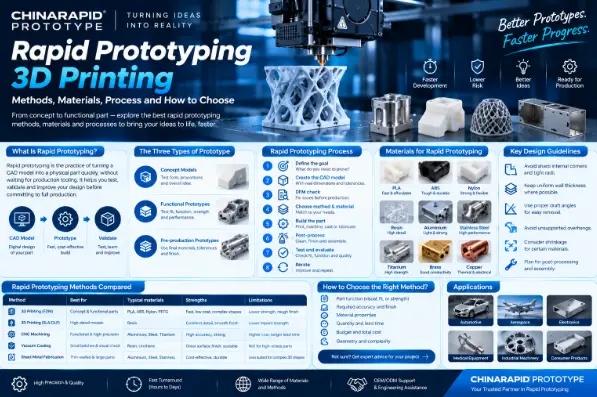
Rapid Prototyping 3D Printing- Methods, Materials, Process and How to Choose
2026-10-23By -
 Blog
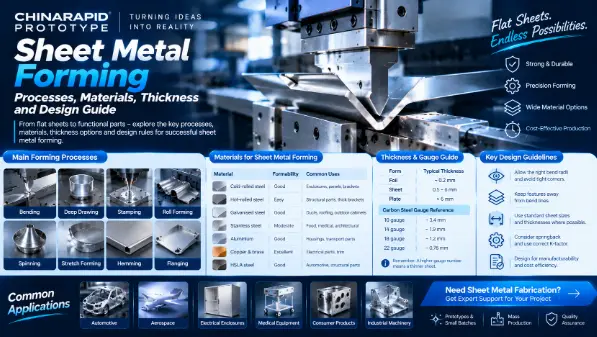
Sheet Metal Forming - Processes, Materials, Thickness and Design Guide
2026-10-23By -
 Blog
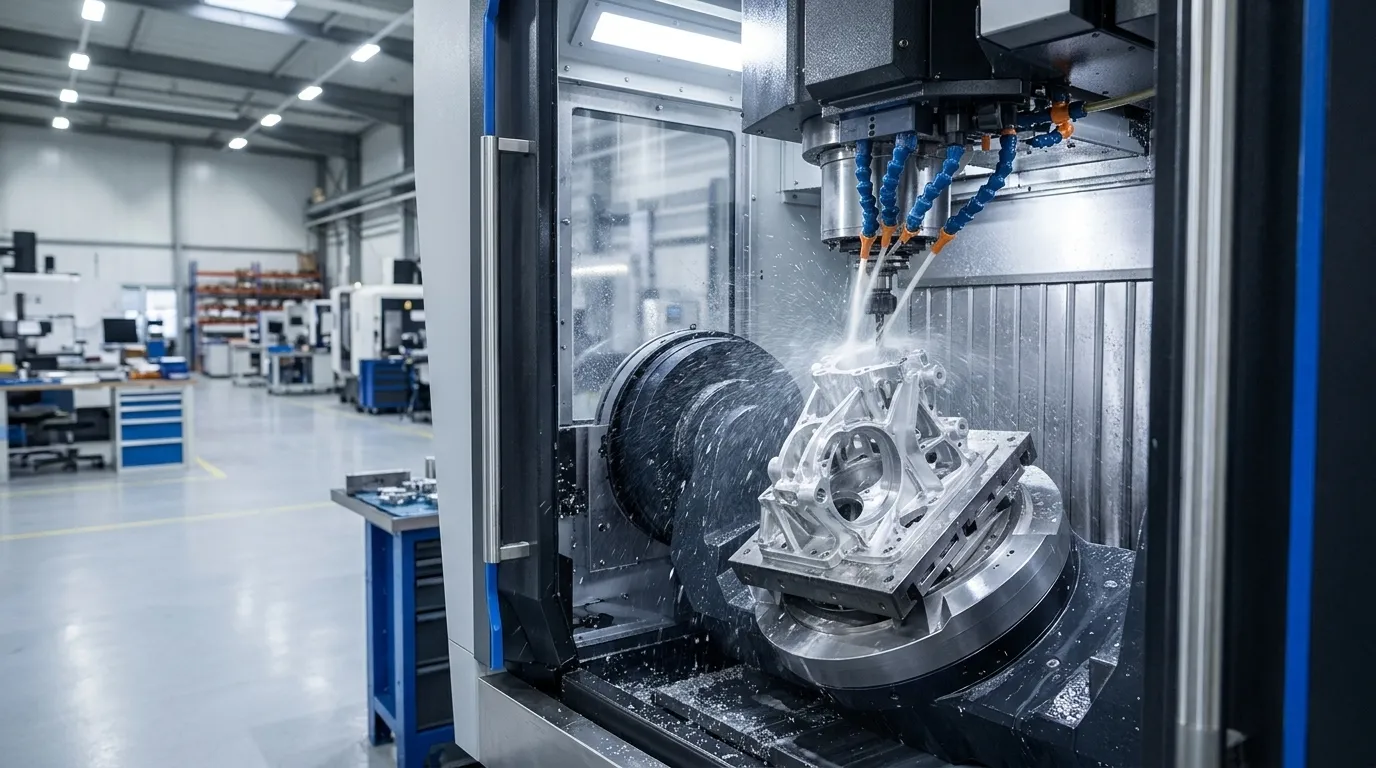
Low Volume Appliance Manufacturing Methods and Processes
2026-10-23By


