
 Contact Us

How Rapid Prototyping Improves Household Appliance Design


Table of Contents

Rapid Prototyping for Household Appliances: From Design to Testing
Household appliances should be a compromise of usefulness, safety, durable materials, and feasible manufacturing expenses. A product might appear beautiful on the screen, but the components can malfunction in the process of assembly or use. Physical prototypes assist engineers in discovering these issues prior to making an investment in production tooling.
Household Appliances Rapid Prototyping enables product teams to test designs, compare materials, and enhance component fit. Various development requirements are supported by 3D printing, CNC machining, and vacuum casting. All the methods provide varying degrees of detail, strength, surface quality, and cost. Through early testing, manufacturers are able to improve the features of the product and minimize design mistakes. It is also a process that assists teams in making wise decisions prior to transitioning to bigger production runs.
The Role of Household Appliance Prototyping in Product Development
Converting Product Concepts to Testable Parts
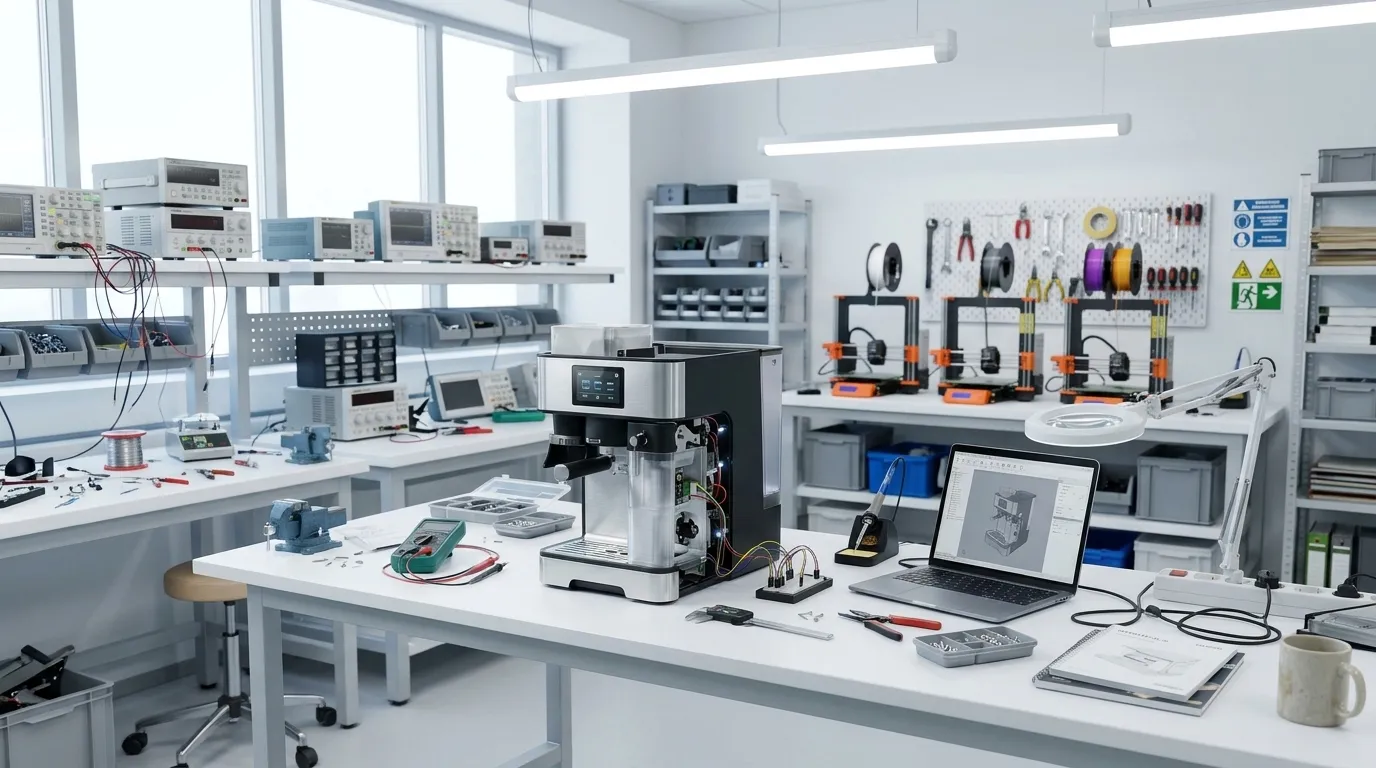
The design of household appliance products does not just entail the development of a nice outer cover. The engineers have to take into account internal space, airflow, heat, vibration, wiring, controls, and access to assembly. Home appliance rapid prototyping converts digital designs into tangible components that can be inspected by teams.
- As an example, a prototype of a blender may demonstrate the problem of clearance around the motor housing. A model of a coffee machine can assist engineers in verifying access to water tanks, positioning of buttons, and the internal routing of pipes. These checks help in validation of appliance concepts prior to the commencement of expensive tooling.
- Household Appliance Prototype Development is also useful in enabling designers to compare multiple layouts. Teams are able to update CAD models, generate new parts, and test changes without having to re-create entire production systems.
Selecting the Appropriate Prototyping Method
Complex Shapes 3D Printing
- 3D printing creates components based on digital models without the need to have specific production molds. Fused deposition modeling (FDM) is applicable to simple housings, brackets, and larger test parts. Stereolithography (SLA) is used to create detailed models with smooth surfaces.
- These processes assist Rapid Prototyping of Home Appliances when teams require rapid design changes. Printed materials can, however, not act as they would with final production plastics. Before subjecting printed parts to demanding tests, engineers are advised to verify their heat resistance, strength, and wear.
Accurate Components CNC Machining
CNC machining subtracts material from hard metal or plastic material. It is appropriate for parts that require precise holes, planar surfaces, threaded parts, or tight-fitting connections. Various testing objectives can be supported by aluminum, ABS, polycarbonate, and other engineering materials.
As an example, CNC-machined motor mounts may assist engineers in evaluating alignment and vibration. Plastic housings that are machined may also offer superior dimensional control to certain printed parts. Tolerance required varies with the size, material, geometry, and functionality of the component.
Consider CNC Machining Options When Designing Precision Parts
Vacuum Casting and Rapid Tooling
Vacuum casting creates small batches of plastic-like components with silicone molds. It is effective when there are a few samples that have the same appearance in a team. Rapid tooling and injection molding are employed when engineers require testing of production-grade plastics or pilot batches.
These alternatives facilitate Home Appliance Prototype Manufacturing by facilitating the initial design activity and production planning. The choice of the process must be based on the amount needed, material characteristics, finish, and test conditions.
Choosing Materials to Use in Appliance Prototypes
The choice of material influences the strength, weight, temperature resistance, surface quality, and the cost of the part. Household appliances usually incorporate stiff cases, pliable seals, metallic supports, and moving components.
Common choices include:
- ABS: Suitable for numerous housings and prototype parts that are impact-resistant.
- Polycarbonate: This is applicable where impact strength and transparency are important.
- PA12 nylon: Can be used in complex components requiring strength and wear resistance.
- Aluminum: This can be used in lightweight supports, brackets, and components related to heat.
- TPU: Can be used with flexible covers and seals, as well as protective features.
The engineers must also take into account chemical exposure, moisture, repetitive loading, and cleaning procedures. A test objective has to be matched by a prototype material. Functional parts do not necessarily have to possess the same properties as appearance models.
Function, Fit, and Safety Testing
Household appliance prototypes are functional and are used to test the functionality of parts. The intended use and the risks associated with each component should be tested. Appliance testing of consumer prototypes may include:
• Checks of dimensions: Check positions of holes, clearances, and mating surfaces.
• Thermal tests: Check the temperatures around motors, heaters, and other hot components.
• Mechanical tests: Assess vibration, load capacity, movement, and repeated operation.
• Electrical inspections: Survey access to wiring, insulation design, and location of components.
• Usability tests: Test grip, button access, cleaning, and routine maintenance.
Design Before Tooling
The best way to do rapid product development of appliances is to have the design and manufacturing teams provide early feedback. A design-for-manufacturing inspection verifies wall thickness, draft angles, fasteners, parting lines, and assembly steps.
- Molding can cause warping of thin plastic walls, and sink marks can be formed by poorly positioned ribs. Close tolerances can also increase the cost of machining without enhancing product functionality. Early inspection assists teams in striking a balance between quality of parts and feasible production requirements.
- The development of home appliance products should encompass evident design changes and checklists. The appliance product development cycle can include concept models, engineering samples, design validation builds, and pilot production.
- This systematic methodology facilitates reproducible outcomes. It also assists manufacturers in determining what parts require new tests prior to production approval.
Uses in Household Appliances
Rapid Prototyping of Consumer Appliances serves a wide variety of products, such as blenders, vacuum cleaners, coffee machines, washing machines, air purifiers, and refrigerators.
- In the case of kitchen appliances, the teams can test the comfort of the grip, the clearance of the blade, the exposure to heat, and the fit of the housing.
- In the case of vacuum cleaners, prototypes are used to test airflow routes, access to dust containers, and motor mounts. Appliances of larger size might require panel alignment, hinge movement, vibration, and internal space checks.
- Prototypes in appliance engineering are also used in product development in consumer electronics, especially where the appliance involves a screen, sensor, control board, or other related functions.
- These applications demonstrate why the design and development of Household products require visual inspection and engineering trials. Every product has to have a test plan depending on its components, working environment, and customer requirements.
Conclusion
A physical prototype transforms design assumptions into fact. Teams are able to verify dimensions, material behavior, assembly, and performance before making a commitment to production tooling. Depending on the part, test objective, and anticipated volume of production, the right process is determined.
Yanmee offers Home Appliance Product Prototyping services, 3D printing, CNC machining, vacuum casting, and other manufacturing services. Contact Yanmee and talk to its team of engineers about your design files, testing requirements, and the next step of development.
- PREV: Null
- NEXT: Null
Talk to the Manufacturer, Not a Middleman
Resources & Insights
-
Blog
Household Appliance Prototyping Services: From Concept to Market-Ready Products
2026-10-26By -
 Blog
Rapid Prototyping 3D Printing- Methods, Materials, Process and How to Choose
2026-10-23By -
 Blog
Sheet Metal Forming - Processes, Materials, Thickness and Design Guide
2026-10-23By -
 Blog
Low Volume Appliance Manufacturing Methods and Processes
2026-10-23By


