
 Contact Us

Household Appliance Prototyping Guide and Key Benefits


Table of Contents

Household Appliance Prototyping: From CAD Design to Physical Testing
Household appliances should be compact, comfortable to use, and reliable to operate in everyday conditions. The digital design will not show all the problems with buttons, fasteners, airflow, or assembly. Physical models allow engineers to experiment with these details prior to investing in production tooling. Household Appliance Prototyping assists teams in reviewing shape, materials, fit, and function, and changes are easier to make.
The correct process is based on the part, test purpose, completion, and quantity. At Yanmee, 3D printing, CNC machining, vacuum casting, and sheet metal fabrication can be combined in teams. This method helps in early checks under actual conditions prior to a product proceeding to production. This provides teams with evidence of design decisions and assists in avoiding unnecessary rework in build phases.
The Reason Appliance Teams Create Prototypes
Home Appliance Product Development involves more than making an outer shell look good. The engineers have to install motors, wiring, sensors, switches, and fans within a small space. A prototype shows conflicts, voids, loose mounts, and inaccessible fasteners prior to tooling. Appliance Engineering Prototypes also assist in evaluating grip, button travel, panel layout, and cleaning access. These checks are important in kitchen appliances, vacuum cleaners, air purifiers, and climate-control products.
Select a Process That is a Match to the Test
Rapid Prototyping of Consumer Appliances can integrate processes in terms of shape, strength, finish, quantity, and test conditions.
- 3D printing helps in rapid shape verification and intricate shapes.
- CNC machining is used to produce precise parts out of metal or engineering plastics.
- Vacuum casting is used to cast small batches of appearance models and plastic-like parts.
- Brackets, covers, panels, and internal frames are supported by sheet metal fabrication.
- Teams may switch techniques when the design shifts from concept checks to functional tests.
Early Design Checks Through 3D Printing
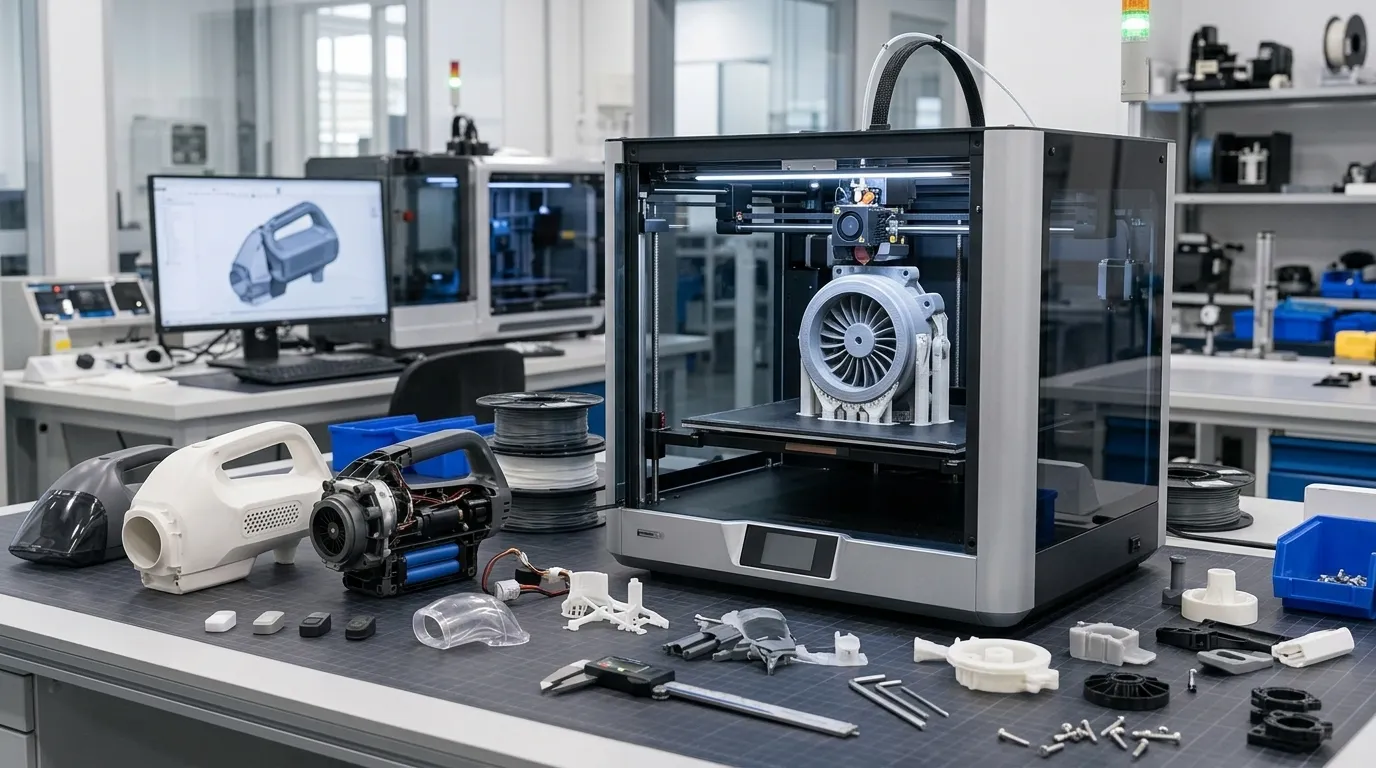
3D printing of Appliance Prototypes assists teams in examining shape, size, and part layout in a brief time. It is capable of making knobs, vents, clips, mock housings, and complicated shapes out of CAD files, without special moulds.
FDM is based on melted filament to check basic forms, whereas SLA uses light to cure resin to fine details. Neither can be used with all loads or heat levels, and engineers are advised to verify material limits prior to functional testing.
Strong, Accurate Parts CNC Machining
- CNC Machining of Home Appliances is appropriate where controlled dimensions, threaded holes, or repetitive assembly of parts are required. A computerized cutter is used to cut metal or engineering plastic to produce housings, brackets, shafts, and mounting components.
- Aluminium is lightweight and machinable. Stainless steel is resistant to corrosion, and POM and nylon are used for selected plastic parts. Select materials according to heat, load, moisture, and wear. Measure critical dimensions using callipers, micrometers, gauges, or a coordinate measuring machine.
Plastic and Metal Prototype Parts
- Plastic Prototyping of Household Appliances assists in checking housings, handles, buttons, vents, and covers. ABS, polycarbonate, nylon, and POM vary in properties; thus, align grade to strength, heat, surface, and use requirements.
- Metal Prototyping of Appliance Components is appropriate for components that require strength, stiffness, or precise interfaces. Frames can be made of aluminium, and brackets and fixtures can be made of steel.
Internal Fit and Appliance Enclosure Prototyping
Appliance Enclosure Prototyping checks the outer shell and its connection to internal parts. Home Appliances Prototype Housing can have seams, screw bosses, vents, clips, cable openings, and control-panel cut-outs. All features require proper alignment and assembly clearance.
Inspect wall thickness, access to fasteners, gaps, panel alignment, cable paths, and airflow. Arrange test vents around fans or heat sources in appropriate conditions. Electrical or safety approval is not substituted by a housing model.
Home Appliances Prototypes
Home Appliance Functional Prototypes assist teams in testing the features they have selected prior to production. They can be used to check buttons, hinge movement, assembly tests, mounting tests, airflow inspection, and simple load tests, depending on materials. Specify what each prototype can demonstrate.
A fan assembly can require clearance, vibration, and airflow inspections. A housing that holds a blender must have a fit check around the motor, and a part of a washing machine may require a mounting and service-access check. Compare tests to anticipated load and temperature.
Appliance Design Checks and Quality Checks
Appliance Design Validation is a comparison of the build and design requirements and test objectives. Household Appliance Prototype Testing should have specific acceptance criteria, including dimensions, assembly fit, button travel, surface finish, or airflow.
Document the part revision, material, process, results, and design changes. Compare and check critical interfaces with drawings, with calibrated tools where necessary. Functional Appliance Component Testing necessitates safe arrangements and competent personnel in the vicinity of electrical, hot, or moving components.
Small and Large Appliance Projects
The devices that are included in Small Appliance Prototyping are kettles, mixers, trimmers, and handheld cleaners. Prototypes are used to test buttons, clips, tight layouts, grip, assembly, and component access.
Large Household Appliance Prototyping can include refrigerators, washers, air conditioners, or dishwashers. Review panels, frames, ducts, structural loads, handling, and access to repairs. Low-volume builds allow groups to test revisions prior to broader production.
Design, engineering, and manufacturing personnel should be involved in prototype reviews. All groups perceive various risks, including user comfort, access to tools, and time to assemble. Note down open issues, owners, and subsequent design changes. Such a basic review process can assist teams in preventing a recurrence of the same debate and make every new build more valuable.
What to Submit to Get a Prototype Quote
A short cut evaluates process, cost, and time. Share these details:
- CAD files and technical drawings containing important dimensions.
- Finish, color, texture, and material preference.
- Sample size and desired delivery time.
- Planned test, anticipated load, and operating temperature.
- Critical fits, threaded features, and inspection requirements.
The service offered by Yanmee assists with design review, prototype techniques, finishing, inspection, and low-volume builds. Details can be found in home appliance prototyping and CNC machining.
Conclusion
A prototype is valuable because it provides a clear answer to a design question. It may demonstrate the fit of parts, the feel of controls, and the functionality of assemblies. To talk about your CAD files, part requirements, and test objectives, contact Yanmee using its home appliance prototyping service.
- PREV: Null
- NEXT: Null
Talk to the Manufacturer, Not a Middleman
Resources & Insights
-
Blog
Household Appliance Prototyping Services: From Concept to Market-Ready Products
2026-10-26By -
 Blog
Rapid Prototyping 3D Printing- Methods, Materials, Process and How to Choose
2026-10-23By -
 Blog
Sheet Metal Forming - Processes, Materials, Thickness and Design Guide
2026-10-23By -
 Blog
Low Volume Appliance Manufacturing Methods and Processes
2026-10-23By


