
 Contact Us

Home Appliance Rapid Prototyping and Product Development


Table of Contents

Home Appliance Rapid Prototyping: From CAD Design to Product Testing
On the screen, a home appliance might appear complete, but minor design flaws can slow down production. Housing can be incompatible with an internal bracket, a button can be stiff, or airflow can be less than desired. Home Appliance Rapid Prototyping assists engineers in detecting these problems when the changes are still manageable. It converts computer-aided design (CAD) files into physical components that can be handled by teams, assembled, measured, and tested, prior to the approval of the expensive production tooling to be used in the intended first production run.
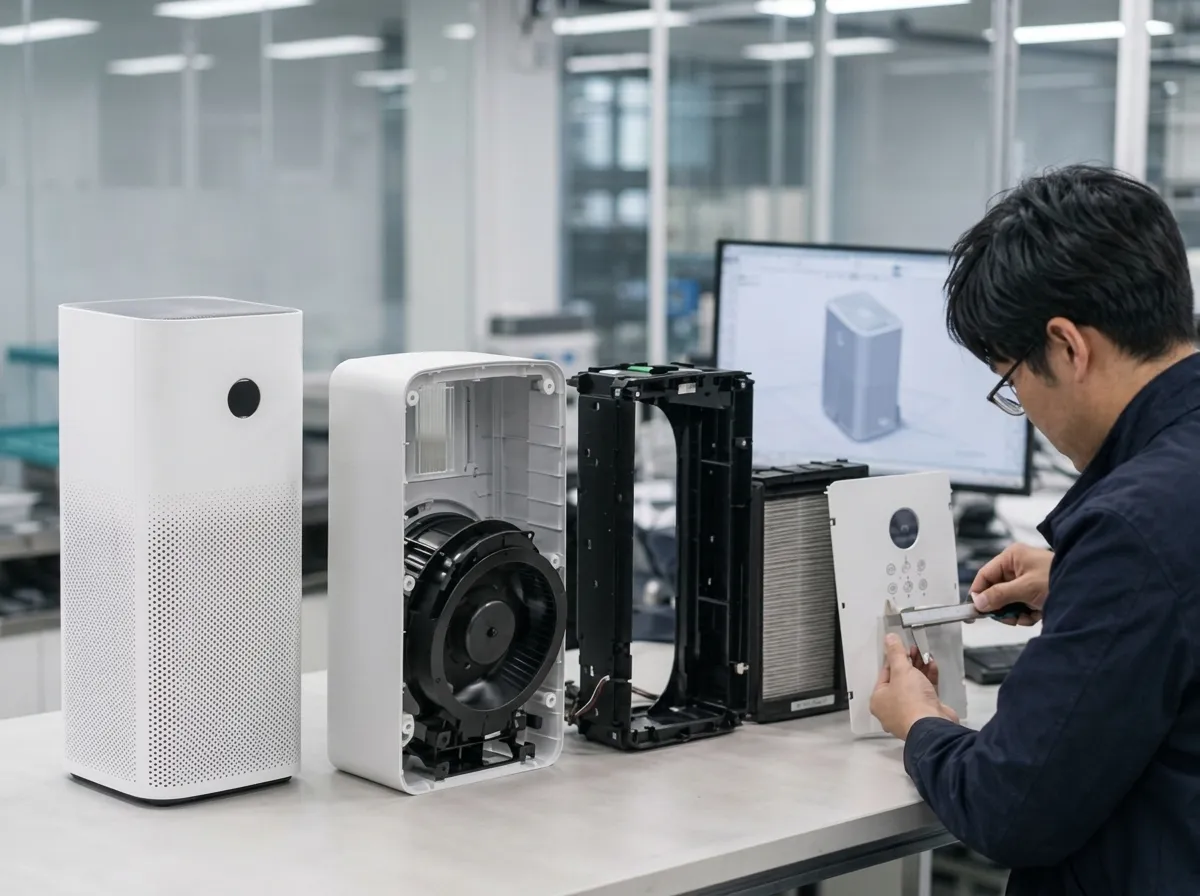
Space is usually limited in the case of products like blenders, coffee machines, vacuum cleaners, refrigerators, and air purifiers. Motors, circuit boards, wires, seals, and vents have to fit into a safe, usable casing. A prototype assists product teams to verify these details prior to investing in production tooling.
The Role of Rapid Prototyping in the Development of Appliance Products
Rapid Prototyping of Home Appliances links initial ideas to real-world engineering tests. Teams can check shape, grip, positioning of buttons, part clearance, and assembly sequence. They are able to make comparisons of design options without creating a complete production mold in each instance.
- This piece is a component of the product development lifecycle. The engineers establish the purpose of the product, develop CAD models, select materials, and construct a prototype. The results of the tests are then used to update the design prior to the next build.
- Product concept testing assists the teams in determining size, comfort, and layout. Subsequently, the development of functional prototypes can verify moving components, mounting locations, airflow routes, and access to components. Every prototype must respond to a definite question, not just mimic the appearance of the final product.
Selecting the Appropriate Prototyping Process
The optimal process is based on geometry, material requirements, surface finish, quantity, and test objectives.
3D printing: SLA is capable of creating smooth and detailed models of appearance, whereas SLS is applicable to complex forms and certain functional components.
CNC machining: This is used to cut parts out of solid plastic or metal. It is appropriate for precise interfaces, threaded holes, mounting, and components that require repetitive assembly.
Vacuum casting: This is a process that produces small batches of resin using a master pattern and silicone mold.
Fabrication of sheet metal: Laser cutting, bending, and joining are used to create chassis parts, brackets, and support frames.
Injection molding and rapid tooling: These assist teams in making the molded samples more similar to the intended production parts.
Selection of Material and Design Tests
The choice of material influences the strength, weight, heat response, finish, and cost. A home appliance is typically made of ABS since it is impact resistant and can be finished cleanly. Polycarbonate is used in applications that require high impact or transparency. Nylon is used on chosen clips, gears, and brackets, but moisture absorption and part position can influence dimensions.
- Aluminum can be used to fit rigid fixtures and precision parts, whereas stainless steel can be used to fit parts that require corrosion resistance. The correct option will be determined by temperature, loads, cleaning agents, electrical requirements, and service life.
- Clear tolerances are also required in the design of appliance engineering. The loose fits rattle, whereas tight ones may not allow assembly once completed. Mark critical dimensions, hole locations, snap fits, screw bosses, gasket grooves, and mating surfaces on drawings. Design for manufacturability (DFM) inspection may indicate thin walls, sharp edges, hard-to-reach tool features, and expensive features. Tolerances should be based on process, material, and part size in case of mating parts. One assembly might have a nominal clearance of 0.2 mm, but that is not a universal rule.
Test, Fit, and Safety Early
Appearance is not the only thing that should be checked in product design validation. A test plan links each design requirement to a measurable result. Teams can test whether a lid closes easily, a control is in place, or a bracket is carrying its claimed load.
Useful checks include:
• Fit and assembly: Check clearances, access to fasteners, alignment, and contact of parts.
• User interface: Review grip, button travel, display view, and access to cleaning.
• Heat and airflow: Measure temperatures and airflow at predetermined test conditions.
• Mechanical action: Vibration checking, moving components, latch strength, and repetitive action.
• Electrical integration: Check enclosure space, cable routing, connector access, and separation from moving parts.
A prototype is not a guarantee of electrical safety, durability, or compliance. These checks require appropriate procedures and competent inspection. Record results to compare design changes.
Enhance the Design Pre-Tooling
Optimization of prototype design is best done in a short feedback loop. Assemble the component, measure, document the problem, revise the CAD model, and test. Include revision numbers on models and drawings to ensure that teams do not confuse versions.
- The vacuum cleaner housing can require additional motor clearance, a redesigned air path, or more powerful screw bosses. A coffee machine might require a better water tank seal or cable space. Such changes can be evaluated more easily prior to the approval of production tooling.
- Acceptance limits should be agreed upon to be used in design verification and testing. Limits can be dimensional, force, temperature, vibration, or cycle count. Load test components.
What to Submit to an Appliance Prototype Quote
Provide explicit project information to assist the team in choosing a process:
- 3D CAD files (STEP or STP) and drawings of important overall dimensions.
- Material, color, surface finish, and amount.
- Mating components, such as fasteners, seals, boards, motors, or provided components.
- The intended use of the prototype, e.g., appearance check, fit test, or functional test.
- Important limitations, such as heat exposure, load, tolerance, and delivery date.
The home appliance prototyping service offered by China Rapid Prototype is used to support external housings, control panels, internal brackets, airflow parts, and low-volume builds. Give the intended use of the test to allow the team to evaluate materials and processes against the actual need.
Conclusion
An effective prototype is not just a model of the shape that will be final. It assists teams to test the design, identify faults, and make wise modifications prior to production. Home Appliance Rapid Prototyping aids component fit, material behavior, user interaction, and manufacturing limits checks at every stage.
Want to evaluate your next appliance design? Send your CAD files, drawings, material requirements, and test objectives to Yanmee. The team is able to look at a realistic path from concept to prototype.
- PREV: Null
- NEXT: Null
Talk to the Manufacturer, Not a Middleman
Resources & Insights
-
Blog
Household Appliance Prototyping Services: From Concept to Market-Ready Products
2026-10-26By -
 Blog
Rapid Prototyping 3D Printing- Methods, Materials, Process and How to Choose
2026-10-23By -
 Blog
Sheet Metal Forming - Processes, Materials, Thickness and Design Guide
2026-10-23By -
 Blog
Low Volume Appliance Manufacturing Methods and Processes
2026-10-23By


