
 Contact Us

Home Appliance Prototyping Services and Methods


Table of Contents

Home Appliance Prototyping Services: From CAD to Testing
All appliances in the home begin with a design that has to perform outside the screen. Components must assemble, cope with everyday tasks, and address the safety requirements of the product. Physical prototypes assist engineers in trying out these details prior to making a financial investment in expensive tools or bulk production.
Home Appliance Prototyping Services convert computer-aided design (CAD) files into physical parts to review and test. These services assist with external housings, control panels, internal brackets, airflow components, and other appliance components. They also assist teams in comparing materials, checking assembly, and enhancing designs prior to production.
Yanmee promotes the development of appliances by using CNC machining, 3D printing, vacuum casting, sheet metal fabrication, surface finishing, and low-volume prototype manufacturing. Its home appliance prototyping service assists product teams to examine appropriate approaches to their designs and engineering requirements.
The importance of Appliance Prototypes in the development of a product
A CAD model will display dimensions and shape, but not all practical questions. Physical components assist engineers in discovering poor fits, weak joints, obstructed airflow, and inaccessible fasteners. These problems can be corrected at an early stage to minimize rework at subsequent stages of production.
Take a refrigerator housing that has multiple internal mounting points. A prototype will demonstrate the suitability of shelves, cables, and cooling components to the available space. Before finalizing the design, engineers have the option of modifying the wall thickness, location of holes, or the shape of the panel.
Check Assembly and Everyday Use
Product Development of Home Appliances is not about making a part appear right. Hinges should swing freely, covers should be able to close, and control panels should be easily accessible. Prototype assembly assists teams in testing these details with actual components. Household Appliance Prototyping Services can also be used to check alignment of parts within an assembly. One misplaced bracket may have a ripple effect on a number of related parts. These issues can be identified by testing the assembled components before production levels rise.
Choosing Materials for Custom Appliance Prototypes
Plastic Prototype Manufacturing
Plastic Prototype Manufacturing is appropriate for parts that require low weight, intricate shapes, or electrical insulation. Covers and housings are typically made of ABS, whereas polycarbonate has good impact resistance. Acetal is suitable in the case of some moving parts due to its low friction and dimensional stability.
Nylon can accommodate some clips, gears, and wear parts, but it is prone to absorbing moisture. This can alter its size and influence its compatibility with other components. Before selecting a plastic, engineers are supposed to compare the heat limits, chemical exposure, load, and moisture requirements.
Metal Prototype Manufacturing
Metal prototypes assist teams in evaluating stiffness, strength, heat transfer, and load-fit. Alloys of aluminium like 6061 are lightweight and machinable. Grade 304 stainless steel is used in parts that require good resistance to corrosion in wet environments.
The material should be suitable to the purpose and working environment of the component. A motor support might require stiffness, whereas a cover might require low weight. The selection of materials according to real requirements assists in cost control and prevents unnecessary machining.
Design of Housings and Internal Components
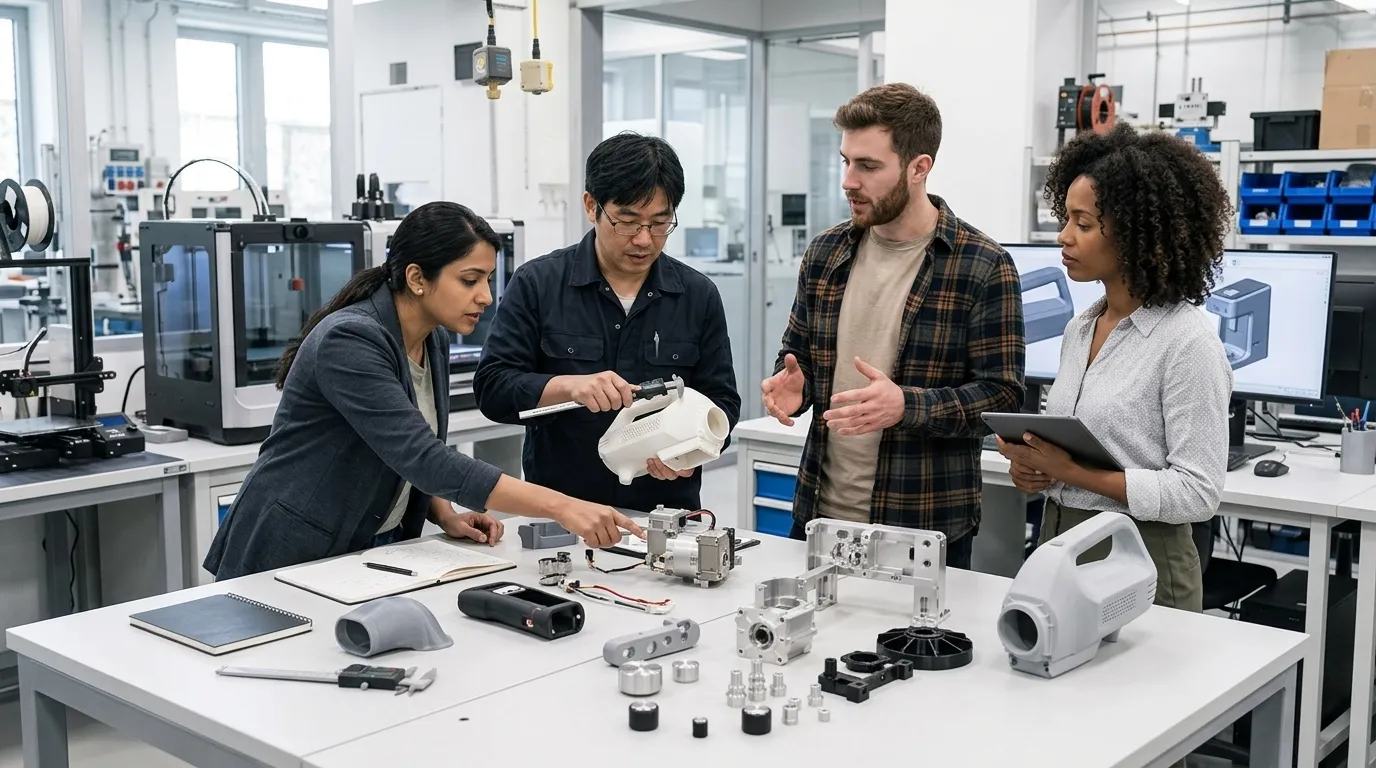
Appliance Housing Prototypes enable engineers to test the area required by motors, wiring, control boards, fans, and seals. The housing should secure internal components and allow air to pass through, heat to escape, and accessibility to facilitate repairs. Holes that are not properly placed or thin walls may result in difficulties during assembly. Household Appliances Prototypes Parts can include:
- External covers, control panels, and access doors.
- Brackets, motor mounts, and support frames.
- Airflow ducts, fan supports, and chosen cooling components.
- Shafts, pins, bushings, and precision fittings.
- Cable guides, mounting plates, and custom connectors.
Custom Appliance Prototyping allows these parts to change as testing reveals new needs. Engineers are able to redesign dimensions, mounting locations, and material options without redesigning the whole product. This assists in maintaining development on the areas that require improvement.
Prototype Builds to Low-Volume Production
As soon as the design is ready to accommodate its primary needs, teams can prepare a small production run. Low-Volume Appliance Manufacturing assists in verifying part consistency, assembly time, finish quality, and manufacturing costs. It also provides the teams with an opportunity to check the production process prior to large orders.
The appropriate approach will be determined by the complexity of the parts and anticipated demand. CNC machining is appropriate for precise parts in metal or plastic, and vacuum casting serves to support small batches of choice. Sheet metal fabrication is effective for panels and brackets, and 3D printing assists in creating updated designs. Before asking for a quote, get ready the most important project information:
- CAD files or engineering drawings with explicit dimensions.
- Favorite materials, finish, and critical tolerances.
- Projected prototype volume and potential future volume of production.
- Purpose, work conditions, and necessary tests.
- Assembly requirements and special inspection requirements.
Clarity of project details will enable the manufacturing team to evaluate the design and suggest an appropriate process. They also minimize time wastage due to lack of specifications or vague requirements.
Conclusion:
An effective prototype will assist teams in identifying errors, testing materials, and enhancing assembly prior to the commencement of production. The correct technique is determined by the shape of the part, the working conditions, and the objectives of testing. Design reviews and explicit test records assist in taking products to dependable production.
To discuss your CAD files, materials, and prototype requirements, contact Yanmee, its home appliance prototyping service. Bring the components that you need to test and the problems that you wish to solve to enable the team to evaluate appropriate manufacturing options.
- PREV: Null
- NEXT: Null
Talk to the Manufacturer, Not a Middleman
Resources & Insights
-
Blog
Household Appliance Prototyping Services: From Concept to Market-Ready Products
2026-10-26By -
 Blog
Rapid Prototyping 3D Printing- Methods, Materials, Process and How to Choose
2026-10-23By -
 Blog
Sheet Metal Forming - Processes, Materials, Thickness and Design Guide
2026-10-23By -
 Blog
Low Volume Appliance Manufacturing Methods and Processes
2026-10-23By


