
 Contact Us

Home Appliance Product Development Guide


Table of Contents

Home Appliance Product Development: From Concept to Manufacturing
A home appliance should not just be a good-looking item on a shelf. It must operate, install its internal components, and be able to endure everyday wear and tear as well as be viable to produce. These needs can be met by careful planning of product teams prior to production. Home Appliance Product Development combines industrial design, mechanical engineering, material selection, prototyping, and testing into a single process.
Plastic housings, metal supports, motors, circuit boards, switches, and seals may be found in a blender, coffee machine, vacuum cleaner, or air purifier. These components should be able to fit into a small space. Heat, vibration, noise, cleaning, and user comfort are other factors that engineers need to take into account. Physical prototypes are used to verify these details prior to the costly production tools being created. An effective development plan provides the teams with a realistic path between the initial sketch and a product that can be manufactured.
What is Included in Home Appliance Product Development?
Home Appliance Design and Development includes the process of converting an idea into a testable, manufacturable product. It is a combination of industrial design, engineering, material selection, prototype construction, and production planning.
It may involve:
• Concept design: Establish the purpose of the product, intended users, major features, and size.
• Mechanical engineering: Design the housing, supports, joints, fasteners, and moving parts.
• Electronic integration: Test the area of circuit boards, wires, sensors, and controls.
• Prototype development: Assemble tangible components to verify fit, form, and functionality.
• Design validation: Test performance, assembly, safety requirements, and anticipated use.
• Production planning: Choose processes capable of producing parts in large quantities and in a consistent manner.
The Process of Making a Home Appliance
1. Specify the Product Requirements.
Begin by noting what the appliance has to do and how it will be used by people. Establish size, weight, power consumption, noise, service life, and price targets. Determine the environments that it will be used in, such as heat, moisture, dust, and repetitive handling.
2. Create the Design and Engineering Model
The exterior shape, controls, and touchpoints are created by industrial designers. The engineers then develop a 3D CAD model of internal parts and their connections. The model assists in exposing conflicts, inaccessibility, ineffective supports, and uncomfortable assembly processes prior to the production of physical components.
Home Appliance Engineering also takes into consideration the airflow, heat transfer, electrical insulation, vibration, and load paths. A fan housing, such as, should have appropriate air passages and safe mounts for the motors. Wall thickness, screw bosses, ribs, snap fits, and clearances should be reviewed by engineers in the design.
3. Select Materials and Production Process
The choice of material influences strength, weight, heat resistance, appearance, and cost. Typical options are ABS in most housings, polycarbonate (PC) in impact resistance, and polypropylene (PP) in lightweight parts of choice. Aluminum can be used in rigid frames and heat-related parts, whereas stainless steel is applicable in areas that require corrosion resistance.
The correct option varies with temperature, chemicals, stress, electrical requirements, finish, and product standards. A plastic that is used in the vicinity of a heating component might require other properties than a plastic that is used on an outer cover.
Home Appliance Manufacturing can be associated with several processes:
• CNC machining: Produces correct metal and plastic components to test functions.
• 3D printing: Makes complicated forms and rapid design cycles.
• Vacuum casting: Provides small batches of detailed appearance parts.
• Sheet metal fabrication: Bends brackets, frames, panels, and internal supports.
• Injection molding: Makes repeatable plastic parts with specific molds.
The Importance of Prototype Development
4. Construct and Test Physical Model
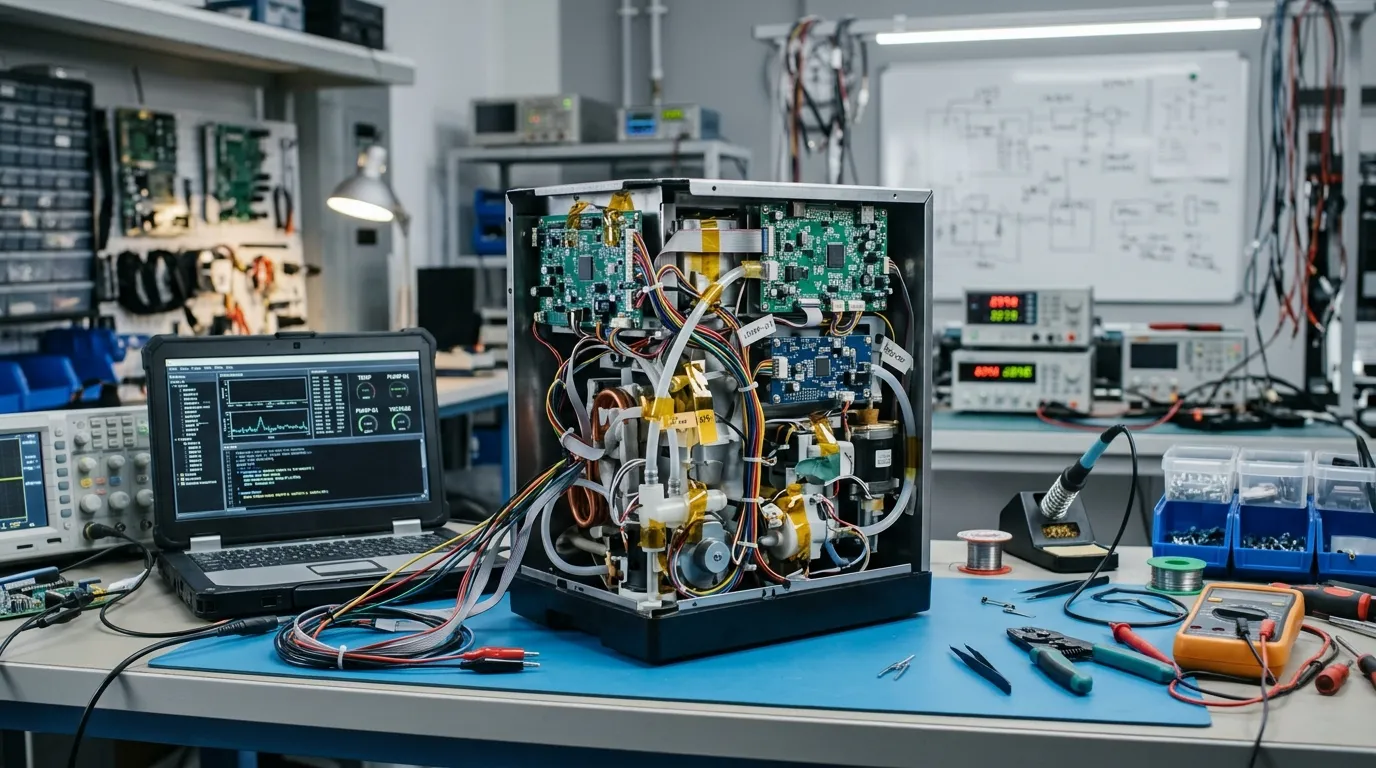
There are many problems that are not exposed by a digital model when it is being assembled or used in reality. A physical prototype allows engineers to examine enclosure holes, button motion, cable routing, access to components, and fastening. It is also useful in enabling teams to evaluate handling, balance, and the feel of user controls.
- There can be more than one method used in the Home Appliance Prototype Development Process. A 3D-printed housing can check shape and layout, and a CNC-machined bracket can check a critical mounting point. Vacuum-cast components may be used to check the appearance of a small batch.
- The prototype parts that Yanmee prototyping services include are housings, control panels, internal brackets, handles, and airflow components. The service page outlines the CNC machining, 3D printing, vacuum casting, sheet metal fabrication, and surface finishing in the development of appliances.
5. Fit, Function, and Reliability Test
The level of risk and intended use of the appliance should be matched with testing. Engineers are able to ensure that parts fit together, controls are moving properly, and that the vents are supplying an adequate amount of air. They are also able to measure vibration, noise, heat accumulation, and repetitive mechanical movement.
Checks that could be useful are:
• Dimensional checking of important interfaces and mounting points.
• Assembly tests to identify conflicts and challenging fastening procedures.
• Thermal tests under specified operating conditions.
• Vibration and noise tests in normal operation.
• Wear, cleaning, and handling reviews of the material and surface.
Appliance Concept to Manufacturing
- After the design has gone through its intended tests, engineers create drawings, material specifications, tolerances, assembly directions, and inspection points. They also consider the way each part will be manufactured and inspected in the process of repeat production.
- Plastic parts that are manufactured in large quantities are usually appropriate for injection molding. Nevertheless, the quality of parts can be influenced by mold cost, draft angles, wall thickness, position of the gate, and cooling. Reviews of early moldability can minimize issues like warping, sink marks, and uneven filling.
Conclusion
A sound appliance begins with an articulate set of requirements and builds strength through engineering, prototype testing, and production review. Checking, heating, material, and assembly Teams that check early can find faults before investing in expensive tooling.
This work is supported by Yanmee, which manufactures prototypes and conducts the engineering process. Call Yanmee to talk about your design files, prototype requirements, material selection, and the path to production.
- PREV: Null
- NEXT: Null
Talk to the Manufacturer, Not a Middleman
Resources & Insights
-
Blog
Household Appliance Prototyping Services: From Concept to Market-Ready Products
2026-10-26By -
 Blog
Rapid Prototyping 3D Printing- Methods, Materials, Process and How to Choose
2026-10-23By -
 Blog
Sheet Metal Forming - Processes, Materials, Thickness and Design Guide
2026-10-23By -
 Blog
Low Volume Appliance Manufacturing Methods and Processes
2026-10-23By


