
 Contact Us

Home Appliance Engineering Prototypes Guide


Table of Contents

Home Appliance Engineering Prototypes: From CAD to Functional Parts
6-A household appliance has to suit its purpose, be functional, and be viable to produce. A computer model can demonstrate the shape, but not how the parts will act when assembled or in operation. Home Appliance Engineering Prototypes assist engineers in testing dimensions, material selection, moving components, and internal designs prior to starting the manufacturing process.
Physical samples also disclose airflow, heat, wiring, and access to fasteners problems. The design can then be revised by teams where changes can be handled. It is a mixture of CAD modeling, prototype production, and practical testing. Every phase must respond to a definite engineering question, such as verifying a housing fit or inspecting a motor mount under load.
The Role of Engineering Prototypes in Enhancing the Design of Appliances
Transform CAD Models to Testable Components
- The design and engineering of home appliances begin with the needs of the product, size constraints, and performance objectives. Computer-aided design (CAD) software is used by engineers to create 3D models of housings, brackets, panels, and internal parts. These models assist teams in verifying dimensions and identifying potential conflicts among components.
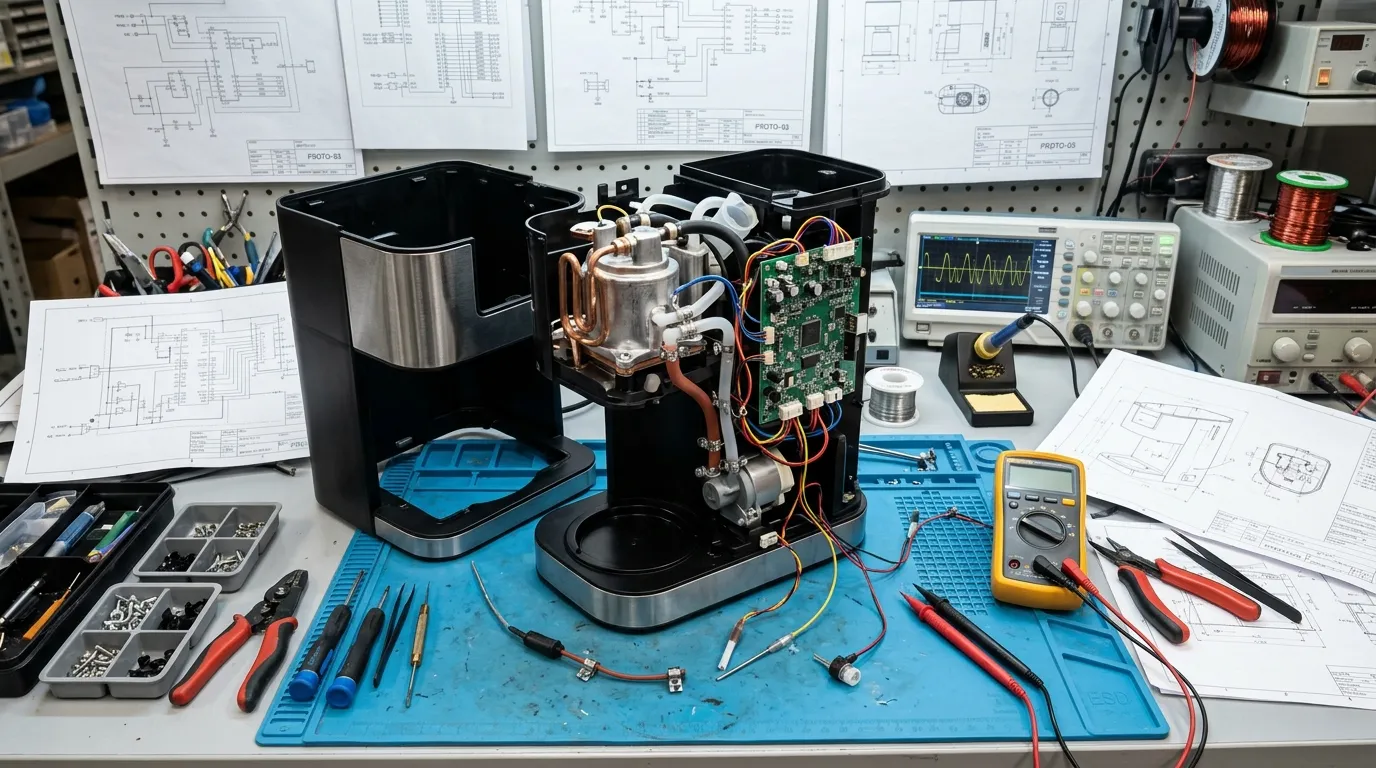
- Another level of review is a physical prototype. To illustrate, a coffee machine housing may be the right size on the outside, but there is not enough room inside to fit pipes or wiring. A vacuum cleaner duct can also block airflow when attached to other components. Early samples assist teams in discovering these problems prior to the escalation of tooling costs.
Choosing the Appropriate Prototype Manufacturing Process
Complex Shapes by 3D Printing
- 3D printing is a method of creating components based on digital models without special molds. It is suitable for custom housings, control panels, brackets, and parts of complex shapes.
- Fused deposition modeling (FDM) is appropriate with simple models and large components. Stereolithography (SLA) is used to create fine details and smooth surfaces. Selective laser sintering (SLS) involves the use of powdered materials, including nylon, to make complex parts in order to perform numerous functional checks.
The correct process is based on the size of the part, its strength, surface requirements, and test conditions. Printed materials might not be as heat-resistant or long-lasting as production plastics.
Accurate Parts CNC Machining
CNC machining is used to cut solid plastic or metal stock. It is applicable to components that require accurate holes, flat surfaces, threaded components, and consistent dimensions.
Motor mounts or structural brackets can be machined out of aluminum. Plastics may be engineered to support housings, guides, and other components. Tolerances should indicate the purpose, material, and geometry of each part. An outer cover might be fitted with a general tolerance, and a motor alignment feature must be controlled more closely.
Vacuum Casting and Sheet Metal Fabrication
Vacuum casting involves silicone molds to create small batches of resin parts. It assists teams in comparing appearance, surface finish, and assembly fit of multiple samples.
Brackets, internal frames, covers, and mounting plates are supported by sheet metal fabrication. These parts can be used together with printed housings or machined parts to form a more complete prototype by engineers.
Selection of Materials to Be Used in Appliances
The choice of material influences the strength, weight, heat response, impact resistance, and the cost of the part. The choice of materials should be determined by the engineers depending on the purpose of the component and the intended test conditions.
The typical prototype materials are:
ABS plastic: Can be used in numerous housings and overall fit inspections.
Polycarbonate: Polycarbonate is helpful in components that require impact resistance or clarity.
PA12 nylon: Resists complicated shapes and numerous mechanical stresses.
Aluminum: It can be used in rigid brackets, mounts, and support components.
TPU: Can be used in flexible grips, seals, and protective features.
Engineering Design Checking and Testing
Engineering design validation is the comparison of prototype results to the stated requirements of the product. Test goals must be specified by teams prior to part construction, and results documented per revision. Prototype testing and engineering can include:
• Dimensional checks: Check gaps, holes, mounting points, and part alignment.
• Mechanical tests: Test hinges, clips, handles, and moving parts.
• Thermal checks: Check the heat around motors, heaters, and ventilation routes.
• Airflow checks: Check intake and exhaust routes in fans or vacuum devices.
• Checks during assembly: Verify access to fasteners, wiring paths, and clearance for service.
• Usability checks: Evaluate grip, control access, cleaning, and normal handling.
Optimization of Appliances by Iteration
- The optimization of appliance products is most effective when the teams make changes on the basis of measured outcomes. When a bracket is bent due to load, the engineers can redesign its form or material. When a panel is not aligned, they may change mounting points or tolerances.
- Appliance Component Engineering Prototypes assist the teams in testing the individual parts without having to assemble the whole product. Engineers are also able to compare versions to determine whether a change will enhance strength, fit, or assembly ease.
- Drawings, material details, test results, and revision notes should be kept together in the home appliance development process. This record assists teams in monitoring design alterations and planning pilot builds.
Solve Product-Specific Engineering Problems
Engineering prototypes assist in kitchen appliances, cleaning equipment, personal-care products, and air treatment equipment. A prototype of a blender can be used to verify the alignment of the motor and the clearance of the housing. One coffee machine model can demonstrate access issues in the area of water tanks and heating components.
- Prototypes of vacuum cleaners assist the teams in evaluating the duct shape, dust-bin fit, and the strength of the handle. The models of air purifiers may assist in examining the access to filters and the location of vents. Smart appliances also might require screen, sensor, button, and cable opening checks.
- Every prototype must be aligned to a specific test objective. This ensures that the development of household appliances is based on practical outcomes rather than on the appearance per se.
Conclusion
Powerful appliance designs require more than precise CAD models. Physical prototypes assist teams to test component fit, material behavior, assembly, and performance prior to production tooling. The correct technique varies with the part, test objective, and the anticipated quantity.
Yanmee provides manufacturing solutions that can be used in various stages of appliance development. Visit the home appliance prototype service to talk about your CAD files, component requirements, and validation objectives. Design your next prototype based on the explicit engineering requirements, and do not engage in full production beforehand.
- PREV: Null
- NEXT: Null
Talk to the Manufacturer, Not a Middleman
Resources & Insights
-
Blog
Household Appliance Prototyping Services: From Concept to Market-Ready Products
2026-10-26By -
 Blog
Rapid Prototyping 3D Printing- Methods, Materials, Process and How to Choose
2026-10-23By -
 Blog
Sheet Metal Forming - Processes, Materials, Thickness and Design Guide
2026-10-23By -
 Blog
Low Volume Appliance Manufacturing Methods and Processes
2026-10-23By


