
 Contact Us

Home Appliance Design Prototyping for Functional Testing


Table of Contents

Home Appliance Design Prototyping: From Concept to Testing
A home appliance should not just be a pretty picture on a monitor. Its housing, controls, moving parts, and internal components should fit together and operate as desired. A minor design mistake may influence assembly, airflow, comfort, safety, or long-term usage. Home Appliance Design Prototyping assists product teams in discovering these problems prior to investing in production tooling.
Through practical trials, engineers are able to study physical components, measure sizes, test various materials, and enhance designs. This is also done to enable teams to determine whether a concept can be produced within their technical and cost constraints. Physical prototypes transform initial concepts into designs that engineers can measure, test, and refine, from kitchen equipment to cleaning equipment.
Why Appliance Design Needs Physical Prototypes
The computer-aided design (CAD) software assists engineers in developing elaborate models of an appliance. Nevertheless, a computerized model is not capable of demonstrating the way users operate a product or how individual components act in the assembly process. These details can be evaluated more easily with a physical prototype.
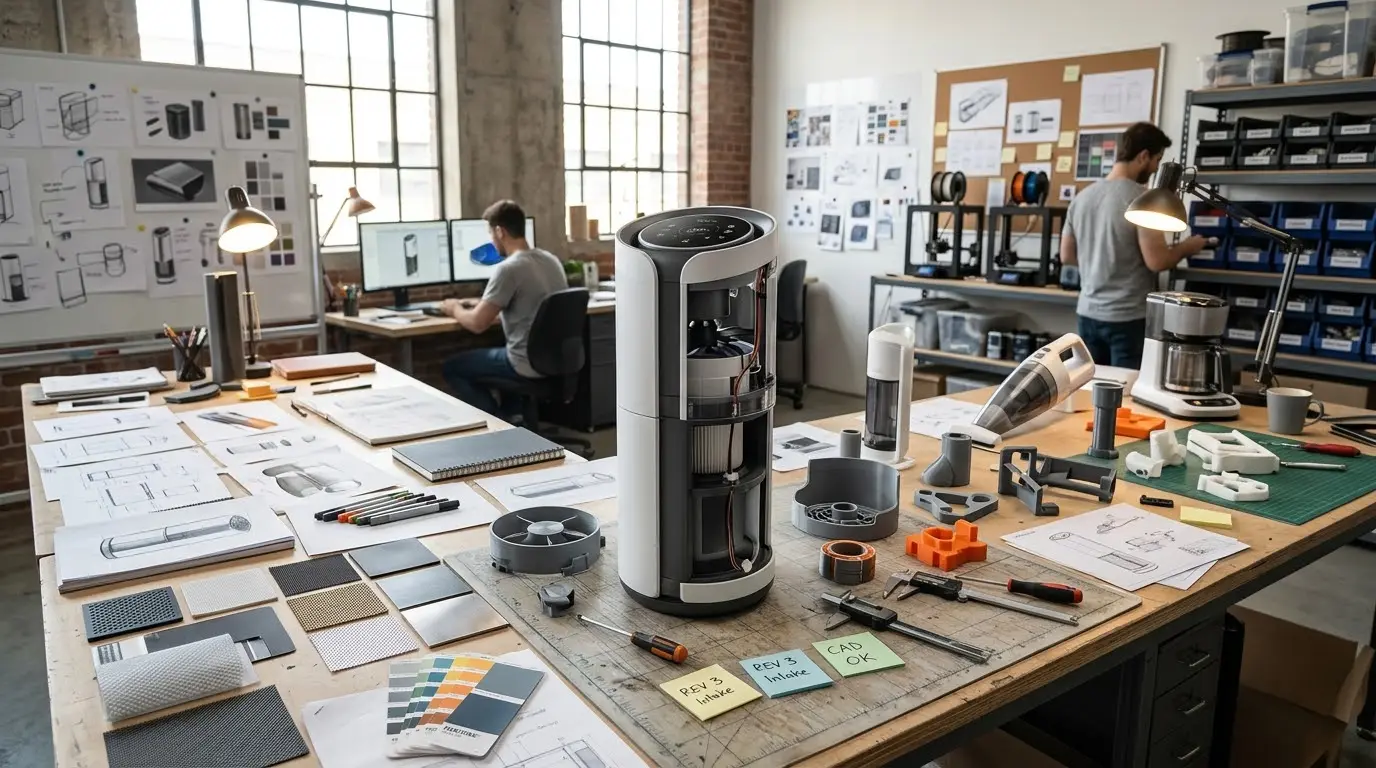
In Home Appliance Prototype Design, teams have the opportunity to check the housing sizes, position of the buttons, panel gaps, screw placement, and interior clearances. They are also able to test the comfort of a handle or the fit of a removable part.
Typical design checks are:
- Fit and alignment of connected parts.
- Control-panel layout, button travel, and display visibility.
- Wire, motor, fastener, and electronic assembly space.
- Airflow paths, ventilation openings, and access for cleaning.
- Surface texture, product color, and overall appearance.
The Home Appliance Design and Engineering Process
Step 1: Product Requirement Definition
Any project must start with well-defined product requirements. These are the size of the appliance, its purpose, the materials to be used, the conditions under which it is to be used, the amount to be used, and the testing that is to be done.
As an illustration, blender housing requires space to accommodate the motor, switches, wiring, and ventilation. A small air purifier must have the appropriate airflow channels, filter access, and space to fit the fan assembly. The various products pose varying design challenges.
Step 2: Develop the CAD Model
The second phase of Home Appliance Product Design is to construct a three-dimensional model. CAD tools enable engineers to specify the shapes of components, mounting points, wall thicknesses, and assembly interfaces.
The model must be realistic in manufacturing constraints. Extremely thin walls can creep during manufacture or handling, or misplaced ribs can cause stress or surface indications. Close tolerances can also lead to higher costs in manufacturing without enhancing the performance of the product.
Step 3: Choose a Prototyping Method
Various components require various production techniques. The correct solution is based on geometry, material, surface quality, tolerance, quantity, and testing objectives.
3D printing is efficient for intricate forms, initial design verifications, and rapid design modifications. Stereolithography (SLA) is capable of creating detailed models with smooth surfaces, and selective laser sintering (SLS) can create complex parts using appropriate nylon powders.
CNC machining is appropriate in parts that require features that are precise and engineering grade materials. The housings, brackets, knobs, and mounting components may be made of aluminum, ABS, polycarbonate, or other appropriate materials.
Selecting Materials to Use in Appliance Prototypes
The choice of material influences the strength, weight, surface finish, heat response, and cost of manufacturing. Instead of picking the material based on its appearance, engineers are supposed to align it with the purpose of the part.
Common Material Options
- ABS plastic presents a convenient tradeoff between impact resistance, machinability, and surface quality. It can be applied to appearance models and housing prototypes if its properties pass the test requirements.
- Polycarbonate (PC) is a high-impact material and can support transparent components. Depending on the grade and operating conditions, it can be used on display covers or inspection windows.
- Aluminum is lightweight, machinable, and widely used. It is effective in support frames, brackets, heat-related components, and precision housings.
- Nylon may be used in clips, gears, and in chosen mechanical parts. When defining dimensions and testing conditions, its moisture response and mechanical properties should be taken into account.
Check Fit, Function, and Performance
A prototype must be evaluated based on specifications and not on its looks. In Home Appliance Prototype Development, engineers have the ability to check dimensions, assemble parts, and test controls or moving features.
- Dimensional inspection verifies that important features are as per approved drawings. An example is that a mounting hole can be required to fit a motor bracket, and a panel opening can be required to fit its display or control unit.
- During assembly testing, interference between parts, inaccessible screws, or gaps due to inappropriate dimensions can be identified. Functional checks can be in the form of handle movement, button operation, airflow, or mechanical motion.
- Extra attention is required in temperature testing. A prototype of a low-heat-resistance resin cannot be a production part that is subjected to constant heat. Engineers ought to choose the appropriate materials and test procedures in the targeted conditions.
Electrical, thermal, and safety tests are to be conducted according to the corresponding product requirements and with the help of the appropriate equipment. The existence of a prototype does not indicate that a completed appliance is in compliance with all the relevant safety standards.
Improve the Design Before Manufacturing
- Prototype testing provides designers with information on how to enhance weak or impractical features. A loose cover can require reformed clips, and a misplaced vent can necessitate reforming of the housing geometry.
- Teams are supposed to document all issues, the cause of the issue, and the design change. They are then able to construct another prototype to determine whether the revision addresses the issue.
- This methodology helps in Home Appliance Product Development by minimizing the number of design and manufacturing mistakes. It is also used to enable teams to make sound decisions regarding tooling, assembly process, and production volumes in the future.
Appliance Design Prototyping Value Addition
Household Appliance Prototyping helps numerous types of products such as:
- Kitchen appliances, including blenders, coffee machines, and food processors.
- Cleaning products, such as floor-care devices and vacuum cleaners.
- Climate-control devices, e.g., fans and air purifiers.
- Personal-care equipment, such as electric grooming products.
- Smart home appliances display, sensors, and control panels.
The design priorities in each category vary. A vacuum cleaner might require airflow and housing inspections, whereas a coffee machine might require close inspection of fluid routes and heat-exposed components.
Conclusion:
An appliance design must have more than just a digital model to be promising. Physical components assist teams in verifying fit, materials, controls, assembly, and performance prior to the start of production. Design changes are also easier to follow and confirm with a clear testing plan.
Yanmee provides Home Appliance Design Prototyping by 3D printing, CNC machining, vacuum casting, and other prototype production techniques. Send your CAD files, material requirements, critical dimensions, and testing objectives to Yanmee to discuss the appropriate strategy to use in your appliance project.
- PREV: Null
- NEXT: Null
Talk to the Manufacturer, Not a Middleman
Resources & Insights
-
Blog
Household Appliance Prototyping Services: From Concept to Market-Ready Products
2026-10-26By -
 Blog
Rapid Prototyping 3D Printing- Methods, Materials, Process and How to Choose
2026-10-23By -
 Blog
Sheet Metal Forming - Processes, Materials, Thickness and Design Guide
2026-10-23By -
 Blog
Low Volume Appliance Manufacturing Methods and Processes
2026-10-23By


